
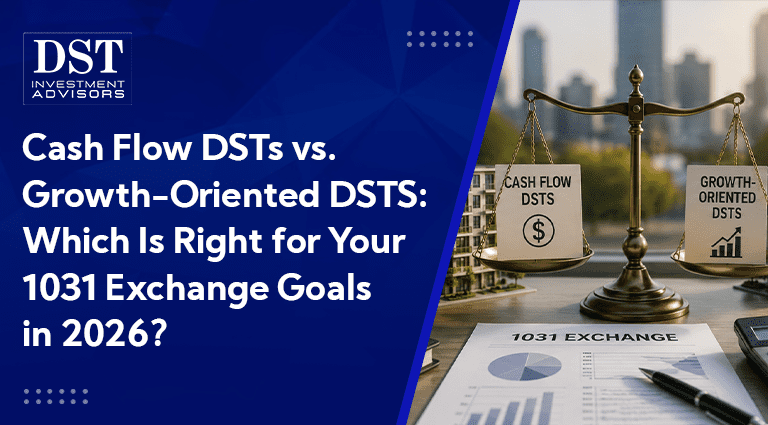
Cash Flow DSTs vs. Growth-Oriented DSTs: Which Is Right for Your 1031 Exchange Goals in 2026?
Introduction
For real estate investors completing a 1031 exchange in 2026, Delaware Statutory Trust investments remain one of the most widely used replacement property options. What has changed is how carefully investors are choosing between different DST structures.
Higher interest rates, tighter credit conditions, and uncertainty around future tax policy have shifted investor priorities. Many are no longer asking which DST has the highest projected return. Instead, they are asking which DST aligns with their income needs, risk tolerance, and long-term exchange strategy.
The most common decision point is choosing between cash flow-focused DSTs and growth-oriented DSTs.
This guide explains the differences clearly using current market data, real-world examples, and practical frameworks investors are using today. The goal is not to persuade, but to help you make a decision you understand and feel confident about.
Cash Flow DSTs vs Growth DSTs
Cash flow DSTs are generally suited for investors who want predictable income and lower volatility after completing a 1031 exchange. Growth-oriented DSTs are better aligned with investors who prioritize long-term appreciation and flexibility for future exchanges.
Neither option is universally better. The right choice depends on income requirements, tax planning goals, age, investment horizon, and how the DST fits into your overall portfolio.
What Is a Cash Flow Focused DST?
A cash flow-focused DST is structured around stabilized real estate that is already producing consistent rental income. These properties are typically well leased, professionally managed, and located in established markets with durable demand.
In 2026, common cash flow DST property types include:
- Institutional-grade multifamily communities
- Net-leased industrial and logistics facilities
- Medical office buildings with long-term tenants
- Grocery-anchored retail centers
How Cash Flow DSTs Perform in 2026
Based on NCREIF Property Index data and sponsor reporting, stabilized commercial real estate assets in the United States produced average annual cash yields between 4.95 percent and 6.25 percent from 2023 through 2025. Most cash flow-focused DST offerings target distributions within this range.
In the current interest rate environment, many sponsors are using conservative leverage. Lower loan-to-value ratios reduce refinancing risk and help preserve investor equity, which has become a priority for income-focused exchangers.
Who Cash Flow DSTs Are Typically Best For
- Investors replacing rental income after a property sale
- Retirees or near-retirement investors
- Those seeking lower volatility and steadier distributions
- Investors focused on capital preservation
What Is a Growth-Oriented DST?
Growth-oriented DSTs are designed to generate returns primarily through appreciation rather than immediate income. These offerings often involve properties with lease-up, repositioning, or market-driven growth potential.
Common growth-oriented DST property types in 2026 include:
- Value-add multifamily in expanding metro areas
- Industrial assets in logistics and distribution corridors
- Self-storage facilities in high-population-growth regions
- Residential rental portfolios in emerging markets
How Growth-Oriented DSTs Perform in 2026
According to long-term data from CBRE and JLL, appreciation-driven real estate strategies outperformed income-focused strategies during periods of strong rent growth between 2014 and 2024. However, annual performance was less consistent and more sensitive to market conditions.
In today’s cycle, growth-oriented DSTs benefit from structural housing shortages, demographic shifts, and inflation-driven rent growth. Distributions are often limited in the early years, with returns realized primarily at exit.
Who Growth-Oriented DSTs Are Typically Best For
- Investors are still in the accumulation phase
- Those without immediate income needs
- Investors planning future 1031 exchanges
- Those comfortable with higher variability in returns
Cash Flow DSTs vs Growth Oriented DSTs: Key Differences at a Glance
Comparison Factor | Cash Flow Focused DSTs | Growth-Oriented DSTs |
Primary objective | Generate consistent income | Maximize long-term appreciation |
Typical property type | Stabilized, fully leased assets | Value add or repositioning assets |
Distribution profile | Regular monthly or quarterly distributions | Limited or delayed distributions |
Target investor needs | Predictable cash flow | Capital growth over time |
Risk profile | Lower volatility, more conservative | Higher volatility, market, and execution risk |
Use of leverage | Typically lower and conservative | Often moderate, sometimes higher |
Sensitivity to interest rates | Lower due to stabilized income | Higher due to financing and exit timing |
Hold period expectation | Medium to long term | Often longer term |
Tax planning impact | Defers capital gains while generating taxable income | Defers capital gains and often delays taxable income |
Ideal investor profile | Retirees, income-focused exchangers | Accumulators, long-term planners |
Portfolio role | Income stability and preservation | Growth and future exchange flexibility |
2026 Market Conditions That Matter for DST Investors
Several market dynamics are shaping DST selection in 2026.
Interest rates remain meaningfully higher than pre 2020 levels, increasing the relative value of stabilized income-producing assets.
Housing supply constraints continue to support multifamily fundamentals across many U.S. markets.
Institutional demand for core assets has increased competition, reinforcing the importance of disciplined underwriting.
Uncertainty around future tax policy has renewed interest in long-term deferral strategies like 1031 exchanges.
These conditions reward investors who understand how each DST structure functions within a broader portfolio rather than relying on a single approach.
Why Many Investors Are Combining Cash Flow and Growth DSTs
An increasing number of exchangers in 2026 are blending cash flow and growth-oriented DSTs within a single 1031 exchange. This approach allows investors to balance current income needs with long-term appreciation and tax flexibility.
For example, an investor may allocate a portion of exchange proceeds to stabilized assets for income while placing the remainder in growth-oriented properties intended for future exchanges.
This strategy can reduce concentration risk and improve overall portfolio alignment.
The Role of DST Investment Advisors
DST Investment Advisors is a 1031 Exchange Advisor in Scottsdale that operates as an education-focused advisory firm dedicated exclusively to Delaware Statutory Trust investments. The firm does not sponsor properties and does not promote one DST type over another. This independence allows guidance to be based solely on investor objectives and suitability.
Paul Hogenson brings deep experience in DSTs, real estate analysis, and 1031 exchange strategy, helping investors navigate complex decisions with discipline and structure. Brenna Winters focuses on investor education and long-term planning, ensuring clients understand how each DST fits into their broader financial picture. Together, they emphasize clarity, alignment, and informed decision-making over transaction volume.
How to Choose the Right DST for Your Exchange Goals
Before selecting a DST, investors should clearly answer the following questions:
- Do I need income now or in the future?
- How long can I remain invested?
- What level of risk am I comfortable with
- Am I likely to complete another 1031 exchange?
- How does this investment fit my overall financial plan?
When these answers are clear, the decision between cash flow and growth-oriented DSTs often becomes straightforward.
Final Thoughts
DST investing in 2026 is less about maximizing returns and more about maintaining control, managing taxes, and preserving flexibility after a property sale. Cash flow DSTs and growth-oriented DSTs serve different purposes, and both can play a valuable role when selected intentionally.
The most successful investors are those who align structure with goals and make decisions based on understanding rather than trends.
Contact DST Investment Advisors to discuss your exchange strategy.
Frequently Asked Questions About Cash Flow and Growth DSTs
What is the difference between cash flow DSTs and growth DSTs in a 1031 exchange?
Cash flow DSTs emphasize regular income from stabilized properties. Growth DSTs focus on appreciation and long-term value creation.
Are cash flow DSTs safer than growth-oriented DSTs?
Cash flow DSTs typically have lower volatility, but all real estate investments carry risk depending on leverage, property quality, and market conditions.
Can I invest in both cash flow and growth DSTs in one 1031 exchange?
Yes. Many investors diversify exchange proceeds across multiple DST strategies.
Which DST strategy is better for retirees in 2026?
Many retirees prefer cash flow DSTs for predictable income, but individual tax, estate, and liquidity considerations matter.
How do DST Investment Advisors help investors choose between DST options?
They provide independent education, analysis, and alignment based on investor goals rather than promoting specific offerings.
Disclaimer
Securities offered through Quincy Wells Capital, LLC, member FINRA/SIPC. Advisory services are offered through Quincy Wells Advisors, LLC, an SEC registered investment advisor. Registration as an investment adviser does not imply a certain level of skill or training. The oral and written communications of an adviser provide you with information about which you determine to hire or retain an adviser.
Nothing in this communication should be construed as a solicitation to buy or sell any investment. Investments in products such as DSTs can only be made through a PPM and are for accredited investors only. This e-mail, including any attachments, is intended only for the person or entity to which it is addressed, and may contain confidential information that is proprietary or privileged. If you are not the intended recipient, please immediately notify the sender by replying to this email and delete the message and any attachment(s) from your system. Any review, retransmission, disclosure, saving, copying, printing, modification or other use of this email message or attachments other than by the person or entity to which it is addressed is forbidden. Quincy Wells Capital, LLC and Quincy Wells Advisors, LLC (collectively “QWC & QWA”) archive and review outgoing and incoming e-mail and it may be produced at the request of regulators or in connection with any litigation. QWC & QWA accept no liability for any errors or omissions arising as a result of transmission. Any proposals, offers or other potential terms described or referred to in this message are “subject to contract” and shall not be binding on any member of QWC & QWA, or any affiliate thereof, unless otherwise expressed and intended or until documented in a written agreement executed by all necessary parties by their duly authorized representative(s). Past performance is not indicative of future results. Please do not convey securities orders via e-mail, as QWC & QWA are not responsible for their timely execution.
The information contained in this email message is being transmitted to and is intended for the use of only the individual(s) to whom it is addressed. If the reader of this message is not the intended recipient, you are hereby advised that any dissemination, distribution or copying of this message is strictly prohibited. If you have received this message in error, please immediately delete it.